
Body Composition Analysis in Louisville, KY


The traditional scale doesn't tell the full story.
- Performed by Dr. Meredith Sweeney, MD, FACS
- InBody 580 | Under 5 minutes | No radiation
- Speaker, Longevity Fest 2025
30-minute call. No obligation. Concierge practice, HSA and FSA eligible.

Reviewed by Dr. Meredith Sweeney MD, FACS
Board-certified bariatric surgeon, A4M member, founder of Sano Longevity in Middletown. Last updated July 2026.
Sano Longevity Program Quick Facts
- Test type: Bioelectrical impedance analysis (BIA)
- Platform: InBody 580 body composition analyzer
- Duration: Under 1 minute
- What it measures: Body fat percentage, segmental muscle mass (arms, legs, trunk), visceral fat area in sq cm, hydration, lean mass
- Key result: Visceral fat in square centimeters (the dangerous fat number your BMI hides)
- Location: 306 Middletown Park Pl Unit D, Louisville, KY 40243
- Price: $50 standalone (included in all memberships, unlimited)
What the InBody 580 Measures That a Scale Cannot
When your primary care doctor measures your body, they put you on a scale, write down a number in pounds, divide it by your height squared, and call the result your BMI. Then they hand you a chart with a color-coded zone. Normal, overweight, obese. They have no idea whether the weight on the scale is fat, muscle, or water. They have no idea where the fat lives.
Two people with identical BMI can have completely different body compositions. One could be 18% body fat with 8 sq cm of visceral fat. The other could be 32% body fat with 65 sq cm of visceral fat. Both show up as the same BMI. One is at moderate metabolic risk. The other has the visceral fat profile of a pre-diabetic. The scale cannot tell the difference. The BMI calculation cannot tell the difference. The InBody 580 can.
Visceral fat area in square centimeters.
The dangerous fat inside the abdominal cavity. This is the number Dr. Sweeney tracks at every retest. Visceral fat drives insulin resistance, cardiovascular disease, cognitive decline, and chronic inflammation. The InBody 580 measures it. Your scale does not.
Body fat mass and percentage.
Total fat mass and body fat percentage, measured directly through bioelectrical impedance rather than estimated from height and weight. This is the number that actually changes when a protocol is working.
Basal Metabolic Rate.
The calories your body burns at rest, calculated from your actual lean mass. This number anchors the nutrition targets Dr. Sweeney sets for you.
Lean mass.
This is muscle and bone, the foundation of your resting metabolic rate and longevity.
Segmental skeletal muscle mass.
How much muscle you have in each arm, each leg, and your trunk, measured separately. Identifies muscle imbalances, muscle loss patterns, and the effect of training protocols on lean mass by body region.
Hydration status.
Total body water and intracellular vs extracellular fluid ratio. Edema, dehydration, and water retention all affect the scale number. The InBody 580 separates them from fat and muscle.
Visceral Fat Is the Single Most Dangerous Fat in Your Body. The InBody 580 Measures It in Under 5 Minutes.
Visceral fat is the fat that sits inside the abdominal cavity, wrapped around the liver, pancreas, intestines, and other organs. Unlike subcutaneous fat (the fat under your skin), visceral fat is metabolically active. It releases inflammatory signals. It drives insulin resistance. It lowers testosterone in men. It contributes to fatty liver disease, cardiovascular disease, type 2 diabetes, and cognitive decline. The only way to know your visceral fat area is to measure it. BMI does not measure it. Scale weight does not measure it. Waist circumference gives a rough proxy but misses patients who carry visceral fat internally without a large waist measurement. Dr. Sweeney considers the visceral fat area in square centimeters the single most actionable number from the InBody 580. It is the number she watches most closely at every quarterly retest.
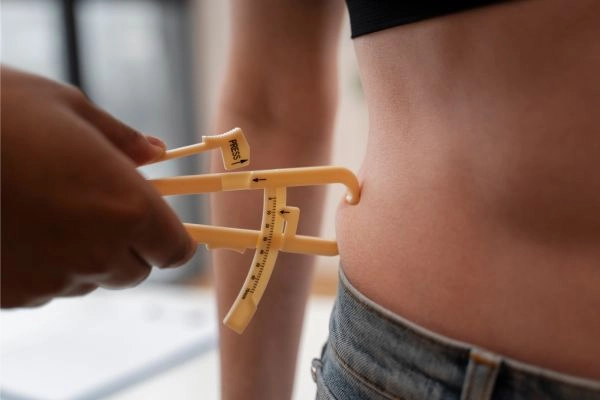
What the InBody 580 Returns: A Complete Body Composition Profile in Under 5 Minutes
The InBody 580 delivers a printed body composition report after every scan. The report includes total body fat percentage, segmental skeletal muscle mass for each limb and trunk, visceral fat area in sq cm, body weight, BMI (for comparison only), hydration status, lean body mass, and the body composition history chart that tracks every measurement across time. Most Sano patients retest every quarter. Patients on the Weight Loss Program often retest more frequently in the first six months to track fat-only loss versus total weight loss. Sano Longevity members receive unlimited InBody 580 scans at all tiers. Retesting frequency is driven by clinical need, not by cost.
Who Should Get a Body Composition Scan?
Anyone whose primary care doctor uses BMI as a body composition measurement.
Which is almost everyone. BMI is a height-and-weight calculation. It is not a measurement of what your body is made of. Two people with the same BMI can carry completely different amounts of fat, muscle, and visceral fat. The InBody 580 measures the difference.
Anyone trying to lose weight.
The number on the scale does not tell you whether you are losing fat, muscle, or water. The InBody 580 does. Without it, you cannot know whether your weight loss protocol is actually working.
Anyone on GLP-1 medication.
GLP-1 causes weight loss. It does not distinguish between fat and muscle. The only way to verify fat-only loss is to measure body composition before, during, and after the protocol.
Anyone building a longevity plan.
Muscle is the organ of longevity. The InBody 580 is how you measure whether you are building it, maintaining it, or losing it. Every Sano longevity patient starts with an InBody 580 on day one.
What to Expect at Your Body Composition Scan at Sano
Step 1 (2 minutes):
You arrive in light clothing, no metal accessories, properly hydrated. You step on the InBody 580 platform.
Step 2 (under 1 minute):
You stand still and hold the grips. A low-level electrical current passes through your body and measures resistance in different tissue types. No radiation. No needles. No discomfort.
Step 3:
The platform generates your complete body composition report. Printed on-site.
Step 4 (approximately one month later, for program members only):
Roadmap appointment with Dr. Sweeney. She walks through your InBody results alongside your VO2 max, resting metabolic rate, and blood panel in a 60 to 90 minute session. Your training and nutrition protocol is built from this data.
Frequently Asked Questions
About Body Composition Analysis in Louisville
Six questions patients ask most often about InBody 580 body composition analysis at Sano Longevity.
What is body composition analysis and why is it different from BMI?
Body composition analysis measures what your body is actually made of: fat mass, muscle mass, water weight, and bone. BMI is a calculation that uses only your height and weight. Two people with the exact same BMI can have completely different body compositions. One could be 18% body fat with 8 sq cm of visceral fat. The other could be 32% body fat with 65 sq cm of visceral fat. Both show up as the same BMI. Sano Longevity uses the InBody 580 to measure where fat lives on the body, segment by segment, and how much of it is the dangerous visceral fat that drives chronic disease.
What is visceral fat and why is it more dangerous than other fat?
Visceral fat is the fat inside the abdominal cavity, wrapped around the liver, pancreas, intestines, and other organs. It releases inflammatory signals, drives insulin resistance, lowers testosterone in men, contributes to cognitive decline, and is one of the strongest predictors of cardiovascular disease, type 2 diabetes, fatty liver disease, and dementia. The InBody 580 measures visceral fat area in square centimeters, which is the metric Dr. Sweeney tracks at every Sano body composition retest.
How does the InBody 580 work?
The InBody 580 uses bioelectrical impedance analysis (BIA). You stand on the platform with your hands holding the grips. The device sends a low-level electrical current through your body and measures the resistance in different tissue types. Fat, muscle, and water conduct electricity differently. The scan takes under 5 minutes, requires no radiation, and returns a complete body composition profile including segmental muscle mass by body part, visceral fat area in sq cm, total body fat percentage, and hydration status.
What does the InBody 580 measure that other body composition methods do not?
The InBody 580 measures segmental muscle mass separately for each arm, each leg, and the trunk. It measures visceral fat area in square centimeters. It returns a complete body composition profile in under 5 minutes, with no radiation. Sano Longevity patients get unlimited InBody scans as part of both the Longevity Program and Weight Loss Program memberships.
How often should I get a body composition scan?
Most Sano patients retest body composition every quarter. Patients on the Weight Loss Program often retest more frequently in the first six months to track fat-only loss. Sano Longevity members receive unlimited InBody 580 scans at all tiers, so retesting frequency is determined by clinical need, not by cost.
How much does body composition analysis cost at Sano?
Body composition analysis is included in both the Longevity and Weight Loss membership programs at Sano Longevity, with unlimited retesting at all tiers. Standalone InBody 580 scans are also available for non-members at $50 per scan. Sano Longevity is a membership-based practice. HSA and FSA eligible. See the pricing page for current standalone rates.
Find Out What You're Actually Made Of.
Book a free consultation. We will walk you through what the InBody 580 measures, what the results mean, and whether Sano is the right fit before you commit.
We respond within 24 hours. No pitch. Just data. Or call (502) 208-6476.
Contact Us
By submitting this form you consent to being contacted about your inquiry. Your information is kept confidential and never shared.
Reviewed by Dr. Meredith Sweeney MD, FACS
Founder, Sano Longevity in Middletown, Louisville. Board-certified bariatric surgeon. Fellow of the American College of Surgeons (FACS) and formerly the American Society for Metabolic and Bariatric Surgery (FASMBS). Member, American Academy of Anti-Aging Medicine (A4M). Speaker, Longevity Fest 2025. More than ten years of metabolic medicine experience at Norton Healthcare before founding Sano Longevity in March 2025.
Sano Longevity
(502) 208-6476